


The defense conversation almost always centers on platforms. Tanks, drones, missiles, fighter aircraft. What that conversation tends to skip is the part of the problem that actually constrains a nation in a prolonged conflict: whether it can produce the consumables those platforms depend on, at volume, safely, and at a cost that does not break the budget. The last three years have made that constraint impossible to ignore. At FISAZA, it is the entire reason we exist.
This is a look at what we build, how we build it, and why I believe the production line, not any single end product, is the part of the defense industry most in need of reinvention.
What FISAZA actually does
FISAZA designs and delivers automated production lines for the defense industry. We are engineered in Croatia, we deliver from the UAE, and our systems are built to be deployed across NATO and allied nations. Our focus is deliberately narrow. We are not a prime contractor and we do not integrate finished weapons. We build the industrial machinery that produces the energetic components at the core of almost every munition: primers, detonators and blasting caps, and the explosive fill that turns a metal body into an effective round.
The reason for that focus is simple. These components are the true bottleneck. A modern army can design a brilliant shell, but if the primer and fill lines behind it run on manual, low throughput, high risk processes, the whole system is capped by its weakest industrial stage. We chose to attack that stage directly.
The technology
At the center of the company is a patented dispensing technology. Dispensing energetic materials with repeatable precision is one of the most difficult and most dangerous steps in munitions manufacturing. Tolerances are tight, the materials are sensitive, and the margin for error is effectively zero. Most legacy plants still solve this with skilled human operators, which limits speed, introduces variability, and puts people directly in the hazard zone. Our dispensing platform is the part of the stack that lets us automate this step at high volume while holding quality and safety where they need to be.
Around that core, the current product family includes three lines:
- A full primers production line, which we are presenting publicly at Eurosatory 2026 in Paris.
- Automated blasting caps and detonator production lines, two of which we have already contracted for delivery.
- A melt cast filling line for loading explosive fill, also under contract.
Each line is built to replace manual, batch oriented workflows with continuous, instrumented production.
The engineering principles behind every line
From an engineering standpoint, four principles govern how we design a line. They are also the four areas where the legacy industry is weakest.
First, automation over manual labor. Full automation is not a marketing line for us, it is the throughput strategy. Manual munitions production is slow and inconsistent, and it ties output to the availability of trained operators. Automating the process raises capacity and, just as importantly, removes people from the most hazardous steps.
Second, safety by design. We build with redundant systems and fail safe logic rather than relying on procedure alone. In energetics, a safety culture that depends on perfect human behavior is a liability. The machine should be the primary layer of protection, not the last one.
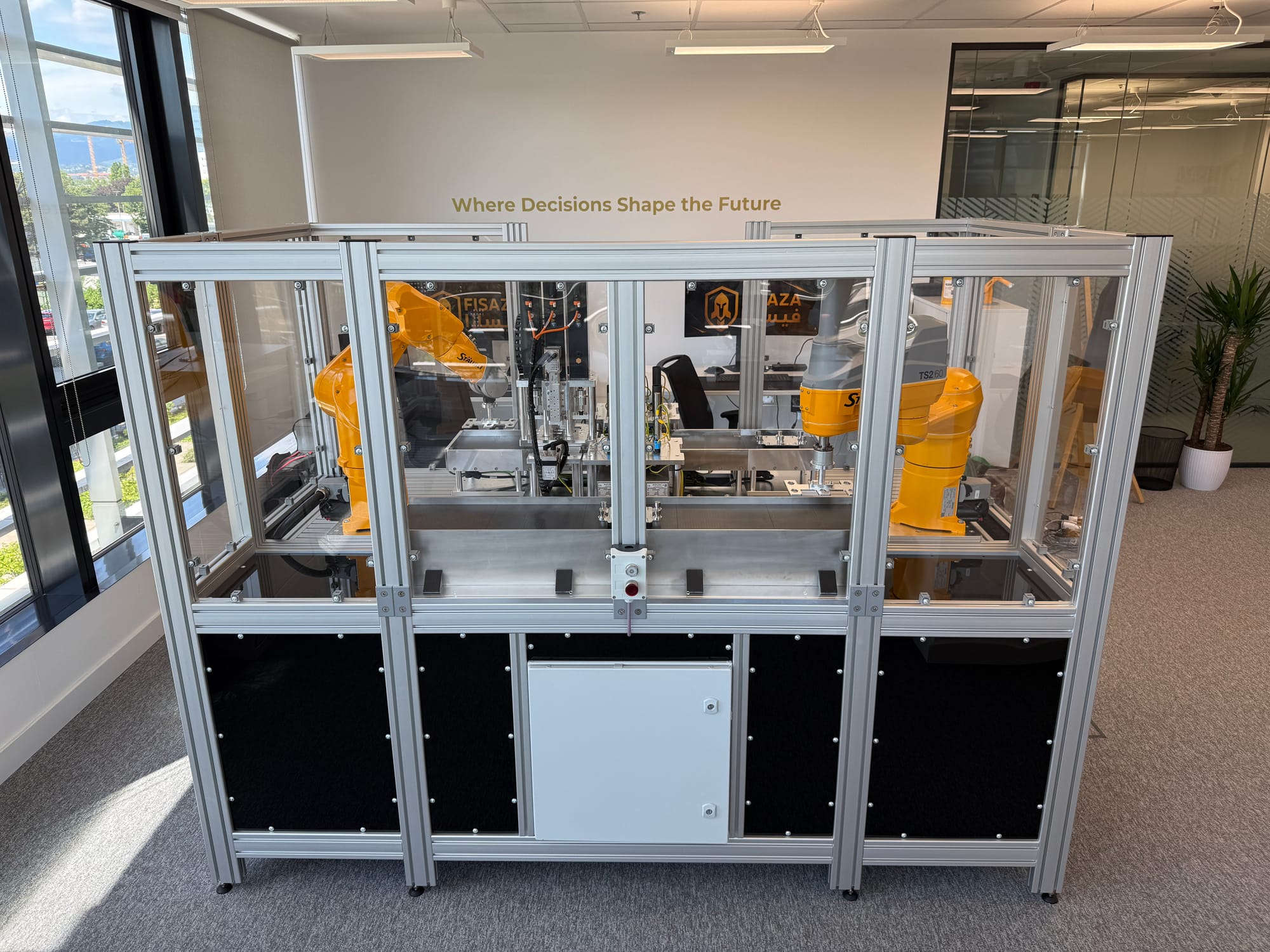
Third, modularity and footprint. Our lines are modular and compact so a customer can scale capacity in increments and fit production into a smaller, more defensible space. This matters operationally and economically. A nation should be able to add capacity without committing to a single enormous facility that takes years to stand up.
Fourth, data and traceability. Every line is instrumented, IoT enabled, and digitally traceable. That gives the operator full lot level traceability, real time visibility into the process, and the data foundation needed for predictive maintenance. In a regulated, safety critical environment, traceability is not a feature, it is a requirement.
The combined effect is the part that interests me most as a CTO. A FISAZA line is not just faster hardware. It is a connected, software defined production asset that produces consistent output at lower unit cost and lower risk than the systems it replaces.
Company and team
The company sits on a deliberate geographic structure. Engineering in Croatia gives us access to a mature and fast moving defense and automation talent base, the same ecosystem that has produced internationally recognized companies in small arms, unmanned systems, FPV drones, and ballistic protection. Delivery from the UAE puts us close to a region that is investing heavily in building its own defense industrial capacity and that serves as a practical gateway to a wide set of export markets.
The team reflects the problem we are solving. It is built around mechanical and process engineers, controls and software engineers, automation and robotics specialists, and people who understand energetic materials and the regulatory environment around them. The work only succeeds when those disciplines operate as one unit, because a dispensing platform is simultaneously a mechanical, chemical, electrical, and software problem.
The traction in the last year has validated the model. We presented at the World Defense Show 2026 in Riyadh, where the response confirmed strong market interest in our production technology and scalable automation platforms. We are preparing to exhibit at Eurosatory 2026 in Paris. We have signed contracts for multiple automated lines and have delivery preparation underway. We are finalizing a strategic project in Croatia, and we are building partnerships in measurement technology, transport systems, and robotics to extend what the platform can do. Out of ten strategic positions we set as targets, two are already secured. That is the early shape of a deliberate expansion rather than a one off win.
The current state of the industry
The macro picture is the clearest argument for what we do. The peace dividend model that the West ran for thirty years, built on lean stockpiles and just in time supply chains, has collapsed under the demands of sustained, high intensity conflict.
The numbers are stark. In the first three months of 2024, Russia reportedly produced what all of NATO produced in an entire year, a four to one advantage. Russian artillery production of 122mm and 152mm shells expanded from 0.4 million rounds in 2022 to an estimated 4.2 million annually by 2025. On the demand side, NATO has identified up to 145 billion dollars in shared munition and air defense requirements across member states, a figure released in its 2025 annual report. The NATO ammunition market alone is expected to grow from about 8.7 billion dollars in 2025 to roughly 11.23 billion by 2031. Total European defense spending surpassed 400 billion euros in 2026.
The harder truth is that money does not equal output. The constraint is industrial, not financial. The bottlenecks named again and again are skilled labor shortages, limited availability of critical raw materials, and a shortage of qualified production capacity. Poland's experience is instructive: an initial target of 150,000 artillery shells annually by 2025 was pushed to 2028, driven by a shortage of skilled labor and missed deadlines.
Read those two facts together and the strategic problem comes into focus. Deterrence today rests less on technological superiority and more on production credibility, and credible production is being held back by exactly the manual, labor dependent processes that automation is built to solve.
The future of the industry
I expect the next decade of defense manufacturing to be defined by a shift in where the value sits. It moves away from the individual round and toward the line that produces it.
Three trends will drive that shift. The first is distributed, modular capacity. Nations are learning that a small number of large plants is a strategic vulnerability and a slow one to build. The future favors compact, modular lines that can be stood up quickly, scaled in increments, and placed where they are needed. The second is the software defined factory. Production assets that are instrumented, traceable, and capable of predictive maintenance will outproduce and outlast the manual plants they replace, and the data they generate becomes a strategic asset in its own right. The third is the labor reality. The skilled workforce required for traditional energetics production does not exist at the scale the rearmament targets demand, and it cannot be trained fast enough. Automation is not an efficiency upgrade in that context. It is the only realistic path to the volumes that have been promised.
This is the gap FISAZA was built for. The industry has committed to producing far more than its current industrial base can deliver, and it has committed to doing so under tighter safety, cost, and timeline pressure than ever before. The answer is not more people standing over more benches. It is reinventing the production line itself.
That is what we mean by defense reinvented. Not a slogan about the future of warfare, but a concrete claim about the future of how nations build the means to defend themselves. The platforms get the attention. The production line decides who can actually sustain the fight. We are betting the company on getting that part right.


